Favorite Things I’ve Written
There are moments, when I’m in the thick of writing my books, when I surprise myself and write something that entertains the crap out of me. A turn of phrase that lands just right, or a visual that makes me laugh out loud. Or, a sentence that feels so true I have to stop and enjoy it.
I thought it would be fun to share a few of those moments with you, so here are a few of my favorite things I’ve written. The passages that delighted me while I was writing them, and still make me smile now.
Big Trouble in Little Italy
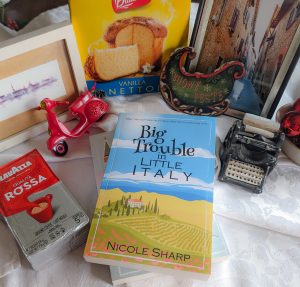 In this book, I needed to get the main character from the airport in Milan, Italy to a hotel in Lake Como. When I wrote the following paragraph, I was trying to capture my own first drive between the two destinations. I was excited and sleep deprived and the whole ride felt like a whirlwind fever dream. I wanted to express that and when I started writing the quick ride, I saw an opportunity to give a few Italian lessons as well. In the end, this ended up being one of my favorite paragraphs.
I learned a few things on my trip from the airport in Milan to the city of Lake Como.
Lago (lah-go) is the word for lake.
Bastardo (Ba-star-do) can be screamed at heavy traffic as needed even if all the windows are rolled up, as long as the horn is honked in spurts to match the scream of ‘Bastardo’, and you wave your hands dramatically at the offending car.
I’m pretty sure the Italian word for fuck is minchia (mink-kia).
Also, because someone tells you it’s going to be about an hour ride to your final destination, that isn’t taking into consideration flying at illegal speeds. But there were never any cop cars that we passed.
I learned that caro (car-o) means expensive, molto (mowl-tow) caro means really fucking expensive. And the damn Villa d’Este was not the butthole of Como, but rather, bellissima (bell-ess-e-ma). Really fucking molto molto bellissima.
Minchia.
Italian For Christmas
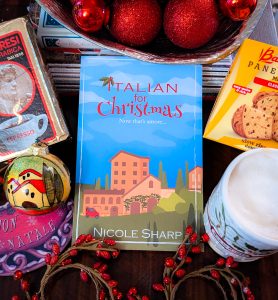 Italian for Christmas is a novella. The thing about novellas is that you don’t have the luxury to …well, luxuriate over the details. Which brought me an interesting conundrum: How do I elongate a romantic meal in the interest of time, without making it feel rushed, but rushing it? I wrote the following scene, and when I was done, I grinned and thrust a fist in the air, ‘Yes!’ I was so delighted with myself.
Isabelle decided if she were ever asked to list what a person should do in their life at least once, she would definitely add: At some point, one should have the opportunity to sit across from someone who looks at them with such interest, it causes time to stand still.
And while time stood still Isabelle drank a romantic glass of red wine; had crostini that melted in her mouth; tortellini in broth that she would probably search the rest of her life to find again; a side of baked onion in a parmesan sauce that was enlightening; and finally, a grilled beef filet that made her question if she even knew what good cooking was.
The entire meal was eaten slowly, reverently; while the wine loosened their bones and increased lowered lashes and suggestive smiles.
Simply Protocol
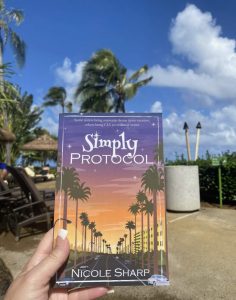 I love this book. It wrote so smoothly and I could just picture every moment of it. But there were two moments when I used descriptions that made me immediately stop writing and call my sister so I had someone to laugh with, because they truly tickled me.
Both are actually a great example of how ‘they’ always say fiction writing should be filled with ‘showing and not telling’ as well as having fun and using different descriptions than we’re used to.
The physical reaction she had to Stills was as frightening as it was electrifying. It was like riding a roller coaster, wrapped in bubble wrap, while Enya played.
and this one…
“Oh honey, I remember everything about that strapping hunk of a man. Six three, muscles straining beneath a polo, a shame about the Dockers, eyes on fire for you.” He ended the description…
Tears of the Moon
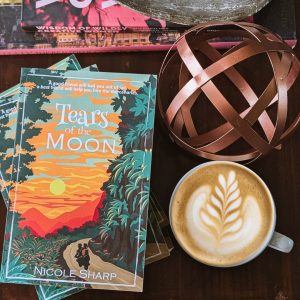 If you’re a regular reader of my books, you know I love to put my characters in situations they might not be prepared for. And I try to think, what would I do? How would I handle it?
My purpose is to bring some humanity into my characters and stories.
I have fun coming up with interesting ways to show mundane things; in this case it was shopping. This was the perfect paragraph to show off the large indoor Mercado in Cusco Peru, the chaotic situation the two main characters found themselves, while also expanding on their characteristics a bit more.
Renee nodded. “You’re right. What else do we need?”
Harper scoured the stalls and bought antibacterial wipes. Baby wipes for possible bathroom emergencies. A small sewing kit, a paracord, a bottle of antibacterial spray and cream. She figured it was the best she was going to do.
The last stall they stopped carried more hardware goods than souvenirs or food. Harper put a pair of tweezers, duct tape and a multi-took on the counter.
Renee asked, “Are we really going to need all this stuff?”
“I don’t know.” Harper let out a frustrated grunt, she was getting tired of that answer. “I feel like we need to be prepared for whatever comes with saving someone who’s been kidnapped.”
Renee picked a pair of pliers off the hook of a pegboard and added them.
Harper added scissors.
Like a game of hand stacking, Renee added a magnet that said Cusco and two pairs of knitted gloves. Harper added zip ties.
Lastly, Renee added two more chocolate bars, a bar of soap and a hand fan.
Harper stopped them. “That’s probably good.”
“I’m spiraling,” Renee excused.
C’mon, the visual of a ridiculous hand stacking game…I loved it.
La Bella Luna
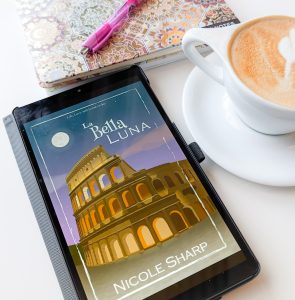 The biggest compliment I get, time and time again, is how people feel I paint Italy (and other locations) so well, they feel they are standing next to the characters taking it all in. And I truly love writing about the places I’ve been in Italy.
I use my own memories, my first impressions, and the journals I kept when visiting. But the fun part, is trying to explain the scenery in such a way that’s a litle different. In the book La Bella Luna, I was able to write romantic days we all dream of spending in Rome.
She followed the suggested route, rounded a corner, and coming face to face with the Pantheon, shuffled to a stop so she could soak up the whole effect the structure was having. It hummed with energy, or maybe that was her. She walked over and touched one of the pillar’s cold marble to see if the vibrations of history could be felt.
“Possibilities abound,” she whispered, then gave a laugh. “Jesus Diana, you’re drunk.”
And she was; she was drunk on Rome.
Standing on the steps of the Pantheon she was aware of the way the blood flowed through her veins, the way the gray dawn sky kissed the surrounding buildings, and she decided it was a glorious thing to be drunk on Rome. She closed her eyes and with her hands still on the night cooled marble, realized it was indeed humming.
Surviving Thirty
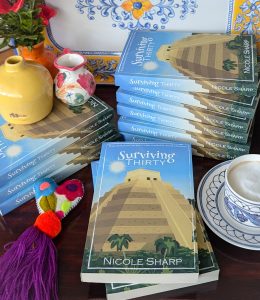 This book, let me tell you, I let go and just had FUN. I ignored constraints and leaned into telling a crazy story that made me happy. It’s told from the first-person perspective, but one of the things I found myself doing was breaking the ‘4th wall’ and talking directly to my readers. The following paragraph came after a very drunken night the characters were having. When I finished the chapter, I stopped and thought, ‘wait, how would the main character know exactly what happened? I’ve been that drunk before, and everything was a little fuzzy.’ Thus, the first fourth wall break:
*Note: To the best of my recollection, this was pretty much how the evening went. Granted, some of the language might not have been as verbally decipherable as I reported it above, but I’m pretty sure we were all on the same page and always completely understanding of each other.
I think.
Pretty much.
At least, you get the gist.
The Italian Holiday
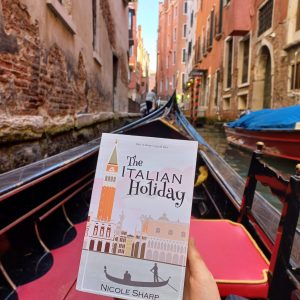 On one of my trips to Rome, I woke early before the rest of the city and tourists and walked the dawn cobblestones, stopping to write in my journal wherever I could find a bench or curb. From that trip, I wrote a piece called A Roma, which was the first time I had this idea of Rome being ‘male’. And when I wrote my book, The Italian Holiday and met Lorenzo … let’s just say I found the perfect time to expand on that idea.
“I think Rome is a man,” I said and was surprised at the catch of emotion in my throat.
Lorenzo tilted his head and offered, “Some would argue Rome is a woman.”
Even though he claimed to be worried, I gestured toward his laid-back position and explained, “Rome is casual, and self-assured. Rome is sophisticated. Rome is comfortable with its history.” A smile spread across his face. “Am I Rome?”
I meant it as a joke, the way people are asked to describe wine and they inevitably describe themselves. But Lorenzo was Rome.
In that moment, he was everything I’d ever studied about Rome, everything I’d ever experienced. The smells, the sounds, even the look of him was Roman.
“I’m just saying Rome is a man.” I sidestepped admitting he was Rome. “Rome is musky. Even now, in the middle of February it smells of heat and dust and sweat.” I inhaled and nodded at my observation. “Rome is sure of itself,” I repeated, “it doesn’t apologize. Rome loves with a fierce passion and thrives on the shoulders of a brutal history and great artists.” I shook my head at my fanciful embellishments and took a sip of wine to cool my tongue. Who would have thought I’d be here today? Amid the pulse of Rome. I finished my assessment, “Rome is most definitely a man.”
Lorenzo gave a grunt of approval in reply.
 Does it matter if an author falls in love with their own words?
It’s more fun if you do.
How many times have you heard the old refrain, if you write a story you love, at least you’ll know one person will enjoy it? If you fall in love with your story, chances are you fell in love with your words.
I love my words, because I’m always pushing myself to try new things. They might not always be noticeable to the reader, but they’re there. In Tears of the Moon, I played with revolving points of view and strived to make sure the reader would always know who the narrator was, no matter what. It was exhausting, but I grew so much as a writer.
I’ve played with movement through a story in my novella The Museum Guide. I had the idea for the story, but it wasn’t until I chaperoned my daughter’s third grade class on a field trip, that I realized a school group would be a great force to move through a space and propel the story forward.
The moments of joy, making yourself laugh, or enjoying your turn of phrase for the love of the words, means your readers will feel that passion too. And there’s nothing wrong with having fun for the sake of the words.
I also know that oftentimes, you won’t always like what you’ve written, or you’ll cut out full scenes and ideas and scribble over what you’ve written in disgust.
But here’s what I believe: none of that is wasted time or wasted words. Even your crappiest version, the sheets of paper where you play with a turn of phrase, poetry written on a napkin in a dimly lit bar, a receipt that carries three words, none of it is wasted.
Each jot, each sentence, each hurriedly typed out paragraph … those are lessons in finding your voice. And when you take the step to write the idea or words down because it meant something to you in that moment…those are not lost words or a waste of time. I would argue those are the most important parts of connecting to your writer’s side.
I hope my writing has entertained you over the years; made you laugh or sigh. I’m grateful for each word and turn of phrase I’ve been able to share with you.
Keep up the good words my friends.

New here?
Start your adventure with a FREE SAMPLE of Big Trouble in Little Italy.

Join My Newsletter
I send one entertaining newsletter each month filled with travel stories, writing updates,
upcoming events, coffee observations, and whatever trouble I’ve managed to get into.